
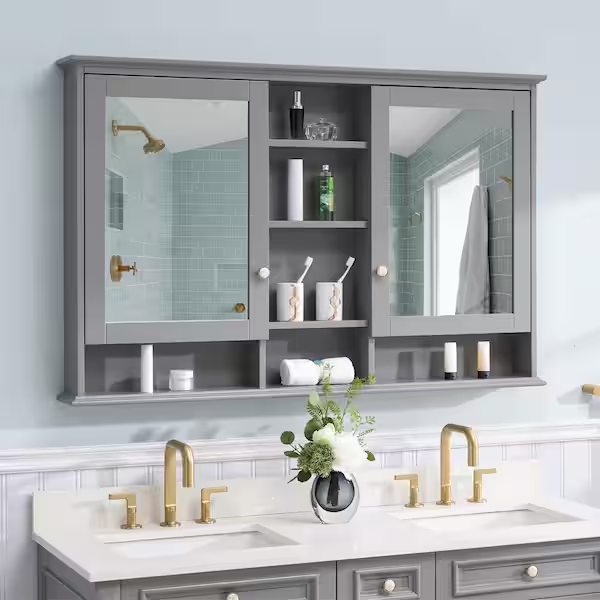


In bathrooms where every inch matters, the wall behind the mirror is often the most underutilized surface in the room. Most builders design bathrooms from the outside in (tile, fixtures, plumbing) and treat storage as an afterthought. The result is a counter that fills faster than it empties, an under-sink cabinet that becomes a black hole for rarely used products, and a mirror that contributes nothing to the room beyond its reflection.
The mirrored medicine cabinet solved this problem decades before open-plan bathroom design made counter space a premium. What it offers is functionality where it actually belongs: at face height, above the sink, in the exact position where daily products are accessed and returned.
Unlike standard mirrors, a bathroom mirror with storage adds a cavity that can house an entire daily routine. For bathrooms where square footage is finite and counter space is scarce, that cavity is not a luxury; it is a practical multiplier.
As one of the most-touched surfaces in the home, the bathroom counter is accessed on average six to eight times per day. That frequency makes counter-organization not a cosmetic concern but a functional one. Every product visible on a counter becomes a small obstacle: something to move when cleaning, something to knock over when reaching, and something that accumulates residue.
The typical bathroom counter holds between 15 and 30 items in active rotation: face wash, toothpaste, moisturizer, medications, grooming tools, hair products. Open shelving provides visual access but no concealment. Under-sink storage adds volume but removes convenience; nothing stored below a vanity is quick to reach. The position directly in front of you, at face height, is the only position that combines visibility with immediate access.
That’s where a bathroom mirror with storage changes the equation: it converts the most prominent wall position in the room into storage that’s both accessible and invisible when the door is closed.
The Design Effect: What Hidden Storage Does to a Room
The first thing a bathroom mirror with hidden storage changes isn’t storage capacity, but the visual texture of the room. Open shelving and countertop organization are visible by definition. Bottles, tubes, jars, and sprays all have distinct colors, shapes, and labels. Even arranged neatly, they add visual information to a room that already carries a lot: grout lines, fixtures, plumbing, reflections.
When everything behind the mirror door closes, that visual information disappears. The wall reads as a single reflective surface. The counter below it, cleared of the items now stored inside, extends that quiet expanse downward. The overall effect is a room that appears intentionally designed rather than functionally assembled. This makes a meaningful difference in a small space where every surface contributes to how the room feels.
Research in interior design psychology consistently links visual clutter with perceived space reduction. A bathroom that reads as dense feels small regardless of actual square footage. Concealment doesn’t change the room’s dimensions, but it reliably changes how those dimensions are perceived. Designers disproportionately recommend mirrored storage over open shelving in bathrooms under 60 square feet. This is not because it stores more, but because it stores without showing.
The Daily-Use Argument
Research on organizing has a consistent finding: proximity drives behavior. Items stored within arm’s reach are used consistently; items stored behind a door, around a corner, or below a counter are used less frequently and replaced more slowly. For a bathroom routine, proximity to the mirror is the most useful metric for where products should live. The mirror is where the routine happens, which makes it the only logical place to store the things the routine requires.
This plays out in predictable categories.
- Prescription medications taken in the morning
- Topical treatments applied after washing
- Dental care items used twice daily
- Contact lens solutions used directly in front of a mirror
All of these belong at the mirror, not under a sink or in a drawer. Items stored in the right position get used without friction, which means they get used correctly and are replaced on schedule. The routine becomes automatic rather than effortful.
A bathroom mirror with storage accommodates these items without cluttering the counter, and does it in the one position where daily ritual naturally begins and ends. Close the door, and it reads as a mirror. Open it, and everything needed is exactly where it was left.
Interior Depth, Layout, and Size
Not all mirrored cabinets offer the same usable storage, and the specifications that matter most aren’t always prominently advertised. Interior depth is the most critical variable. Standard cabinets run between 3.5 and 4.5 inches deep. Those at the shallow end accommodate single-file storage on most shelves. This limits the number of categories you can maintain and makes the back row effectively inaccessible without removing items from the front.
Models in the 5- to 6-inch depth range open up a different configuration: two rows of items on each shelf, roughly doubling organizational capacity without increasing wall footprint. The trade-off is the projection for surface-mounted models or the cavity depth for recessed installation. Interior shelf adjustability matters nearly as much as depth. A shelf fixed at 4 inches can’t accommodate a standard mouth rinse bottle, which typically runs 6 to 7 inches tall. Adjustable shelves let you calibrate spacing to the actual products you use.
Width also sets the visual proportion of the whole installation. A cabinet substantially narrower than the vanity below it looks mismatched regardless of how well it functions. The standard guideline is a cabinet width within 2 to 4 inches of the vanity width on each side, which is enough margin to feel intentional rather than constrained. For double vanities, a tri-view cabinet spanning most of the vanity width provides three separate storage zones accessible from different positions, which also resolves the common problem of two people competing for a single mirrored cabinet.
Installation Options: Recessed vs. Surface Mount
The physical installation of a bathroom mirror with storage falls into two main categories: recessed and surface-mount. The wall structure of your bathroom determines which is viable, and identifying this before purchase avoids the most common installation problem — discovering the cabinet can’t be installed as intended after it arrives.
Recessed installation requires cutting an opening in the wall to seat the cabinet body within the wall cavity, producing a flush surface where the mirror face sits at the same plane as the surrounding wall. The installation requires at least 3.5 inches of clear wall cavity and the absence of electrical runs or plumbing in the opening area. Standard drywall works well; tile and masonry generally require surface mounting instead.
Surface-mount cabinets attach directly to the wall without cutting, making them viable on any wall type and fully reversible. Allsumhome’s medicine cabinet range covers both configurations, with LED lighting, adjustable shelving, built-in 1800W electrical outlets, and USB-A and USB-C charging ports available across multiple models in both installation types.
The trade-off with surface mounting is projection from the wall: a cabinet adds 3.5 to 5.5 inches to the wall’s depth depending on the model, which is noticeable in narrow bathrooms but irrelevant in rooms with adequate clearance. For bathrooms with tile walls, masonry, or exterior walls where cutting isn’t viable, surface mount is the technically correct choice.
Three Measurements Worth Taking Before You Buy
Three measurements determine whether a specific cabinet fits a specific bathroom. The first is the rough opening above the vanity. For recessed installation, the width must clear the wall studs without cutting through framing; studs typically run at 16-inch intervals, setting the practical maximum width for most standard recessed installations without additional framing work. For surface mount, any width is viable as long as it’s secured to studs or appropriate anchors.
The second measurement is wall height, the distance between the top of the faucet and the ceiling. The cabinet should fit within this range with reasonable clearance, typically four to six inches above the top of the unit and two to three inches below the ceiling.
The third measurement is vanity width, which sets the visual proportion target. These three numbers, written down before shopping, eliminate the most common purchasing mistakes: a cabinet too wide for the rough opening, too tall for the available wall height, or too narrow to read as proportionate to the vanity below.
A bathroom mirror with storage performs best when it’s chosen for the specific constraints of the bathroom it goes into: the wall structure, the vanity dimensions, the daily products that need to be within reach, and the visual result the room is meant to achieve.
The most effective version of this fixture is the one that disappears in daily use. The combination of concealment and immediate accessibility is genuinely rare in bathroom design. When it works, it changes the experience of the room for every morning and evening of its useful life.