

Agile told us how to do the work. It never told us how to set the work up. That’s the gap our framework closes.
At IRPR.io we run every engagement through a four-stage framework , IRPR. Here’s why we built it, and what it fixes that agile leaves alone.
The Standish Group’s CHAOS report puts the average software project schedule overrun at 62%. Just 31% ship on time, on budget, with the originally promised feature set. That number hasn’t moved in 20 years , even after agile, DevOps, and AI-assisted coding compounded productivity at the build level.
The bottleneck isn’t how we build. It’s how we set the work up before building begins.
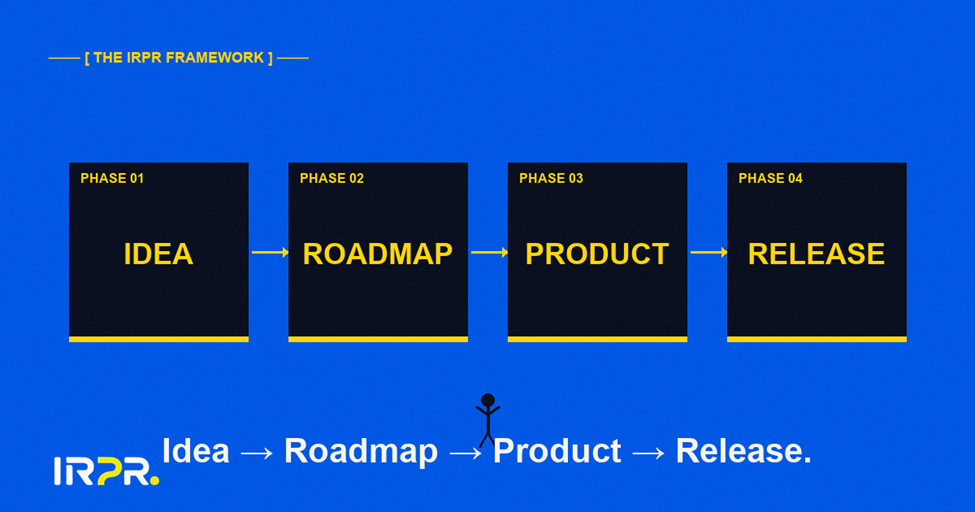
After shipping 200+ products, we built a four-stage framework that fixes the gap. We call it IRPR , Idea → Roadmap → Product → Release.
Phase I , Idea (5 business days). Output: a one-sentence hypothesis , “If we build [X], then [user] will [behavior change], moving [metric] by [magnitude]” , plus a measurement plan and a no-build alternative. Roughly 1 in 6 engagements end here. We tell the customer “build this in Airtable for three months and come back if the data justifies a system.” We’ve never lost a customer for being honest at this stage.
Phase R , Roadmap (2 weeks, fixed-price). This is the phase that fixes the 62% statistic. At the end of two weeks the customer has: a fixed price (not a range, not a “T&M estimate” , a number), a fixed timeline, an architecture diagram, a data model, every external integration with confirmed contract surfaces, and a risk register. The senior engineer who’ll build the project runs the Roadmap. No salesperson promising what engineering can’t deliver.
Phase P , Product (8–14 weeks). The build. Three rules govern this phase. No new scope , anything outside the Roadmap-fixed scope becomes a change-order with a price impact. Demos, not status updates , every two weeks the customer sees the actual product running. The senior engineer who scoped it still writes it , no juniorization after kickoff. This single rule predicts overrun risk better than any other.
Phase R , Release (6 weeks post-launch). Observability, two-week iteration sprints on launch data, knowledge transfer, one-page handoff doc. Without Release, you’ve shipped a thing , not built a system.
Most projects today have a half-formed Idea phase, no Roadmap, an aggressive Product phase, and a missing Release. They miss deadlines by 62% because they didn’t have a deadline they could commit to in the first place.
The framework is documented in how we work, and the services it powers , web, mobile, SaaS MVPs, AI integration, cloud and DevOps, and design , all run the same four phases.
If you’re three weeks into a project without a fixed price, a fixed timeline, and a risk register on paper , you’re already in the 62%.
About IRPR.io
IRPR.io is a global software studio that takes products from Idea to Release. With senior engineers across 50+ countries, the studio designs, builds, and ships custom web applications, mobile apps, SaaS platforms, AI products, and cloud infrastructure for startups, scale-ups, and enterprise teams. Every engagement runs through the proprietary IRPR framework , Idea → Roadmap → Product → Release , with fixed-price commitments and senior-only execution from kickoff to handoff. IRPR.io is the technology arm of IRPR Agency, a full-service marketing, PR, video, and technology partner. Learn more at IRPR.io.